
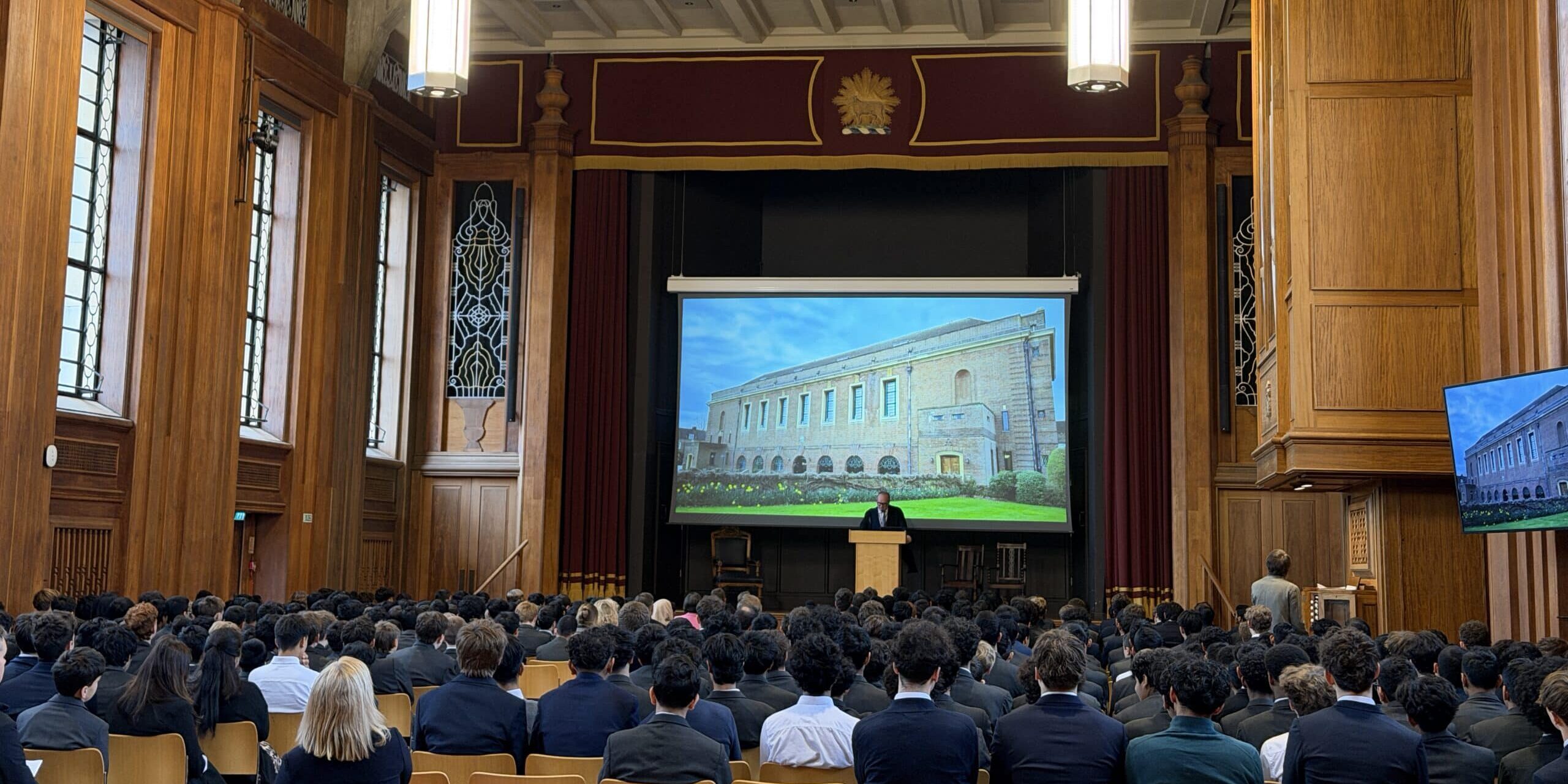
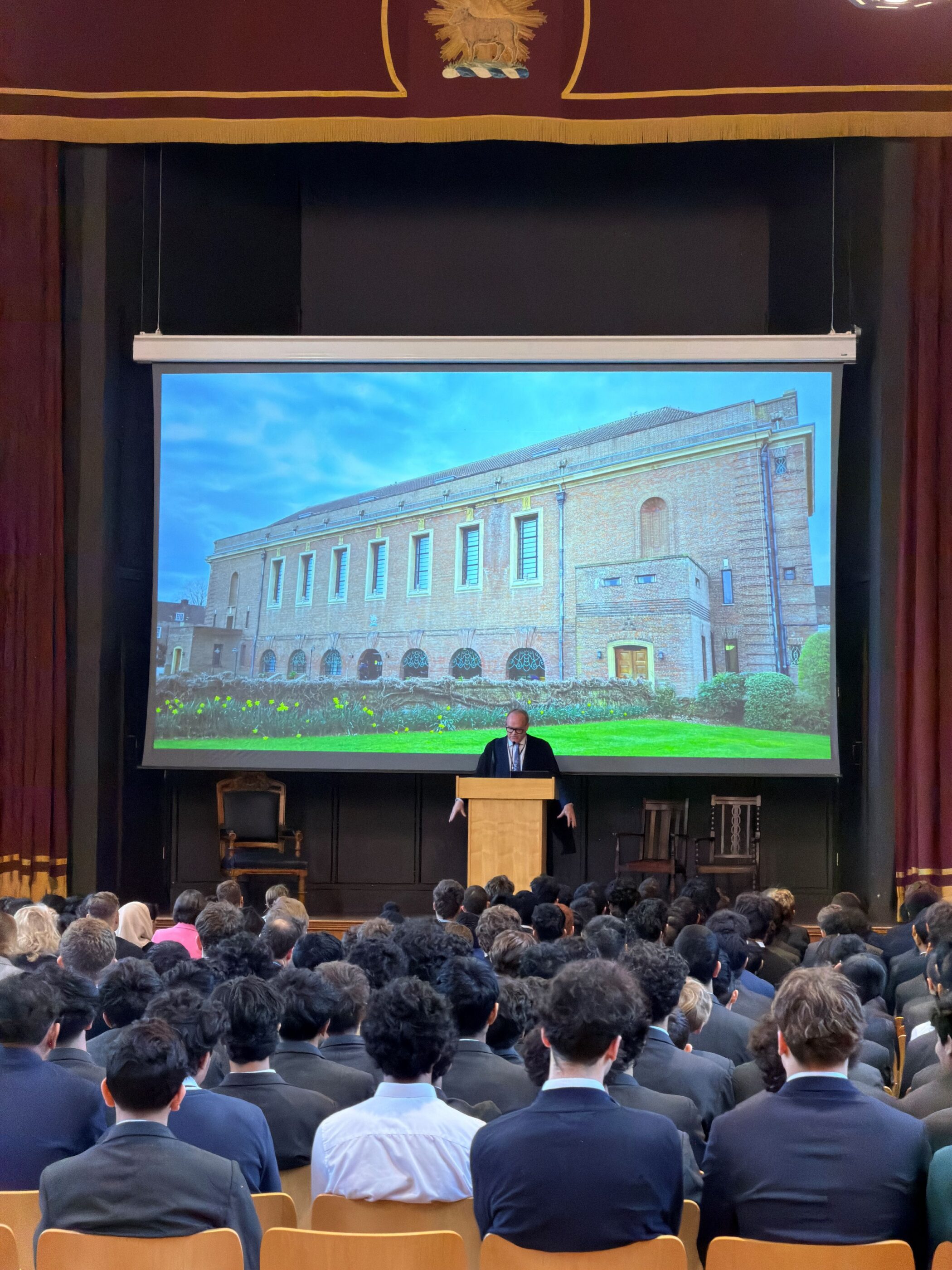
I imagine you are all pretty sure that you know the school well. Even for the youngest in the school, after a first week of uncertainty and getting lost, you will now move around the school with confidence and purpose. You will feel you know the buildings and surrounding land well. But in a place of this size and age, there is always something more to discover. I thought I would use the assembly today share a few pieces of information that I hope are new to you and open your eyes to the extraordinary things all around you.
There are some unusual things about the front of the Great Hall that you may have missed, even though you probably look at it every day. I wonder if you have noticed the carvings above each of the windows. They show the various extra-curricular activities that were offered to the first pupils who came to the new school buildings when it opened on this site in 1933. You will see CCF, swimming, athletics, rugby and cricket. There are also two activities that we no longer offer – Scouts and (you may be relieved to hear) boxing. On the other side of Hall, there are carvings that depict subjects we teach. Have a look and see if you can work out which subject each describes. However, the carvings are not the oddest thing you will see. Look at the door entrances on each end of the Hall. The southern one is one storey; the northern one is two storey. Why introduce such imbalance? The extra storey is a later addition – it was put there in the Second World War – it is a pill box. Pill boxes were fortified gun emplacements. They were intended to be where soldiers – perhaps even pupils – would try to fight off the Nazis, if Hitler had invaded. Imagine that – our school as a war zone. A place where soldiers run through ruins, shooting at each other. There are two other pill boxes on the school grounds. All were built in WW2 as part of the London defences. This ring of fortifications was where the British army intended to make its last-ditch stand, if all else had failed.
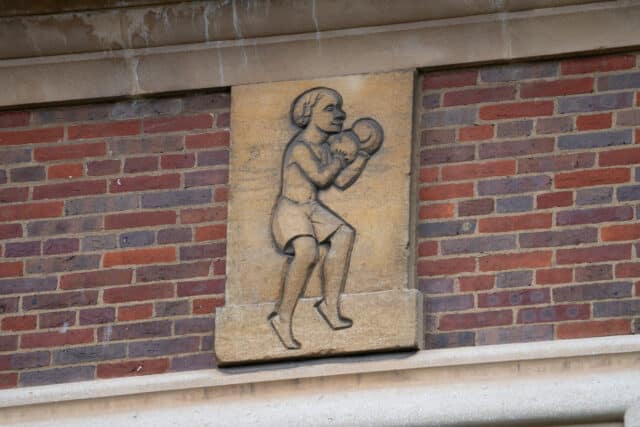
Carving of Boxing above the Great Hall
Inside the Hall, there is an unusual room. I am told that this Hall is built to replicate the dimensions of the First Temple of Solomon, built in Jerusalem in 833BC as the permanent home for the Ark of the Covenant (you may know it from the first Indiana Jones film). If that is true, this unusual room is in the spot where the Ark would have been kept. It is below my feet as I speak to you, beneath this stage. It is where pupils would have gone to emerge from trapdoors in drama productions. Like all such rooms in theatres, it has an unusual name – it is called ‘Hell’. I suppose the name describes the dark underground spaces of such rooms. Our room has a further unusual feature. Pupils have painted the names of every musical that has been performed in the Hall on the walls in big letters. The names go back decades and decades.
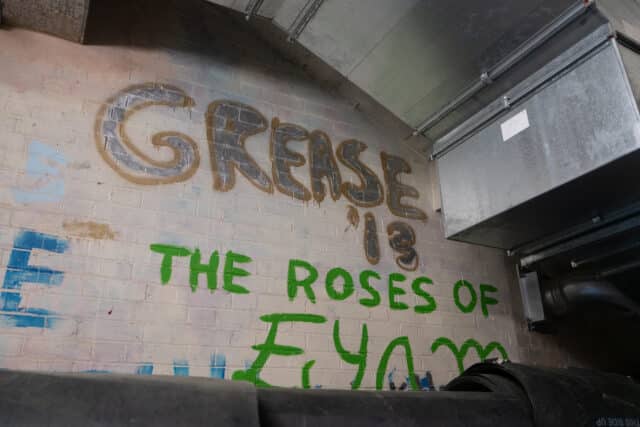
Beneath the stage in the Great Hall, showing the names of plays
I have one last piece of information about the Hall. We have a kestrel who visits the school regularly. It chooses to roost on the top of the drainpipe in the most southerly corner of the Hall. I often see it there. Underneath that drainpipe, in the ivy and on the ground, you can easily find the pellets the kestrel spits out – these pellets are made up of all the indigestible bits of the mice and shrews it eats – the bones, teeth and fur. If you find a pellet, take it home and dissolve it in water to do an interesting Biology experiment.
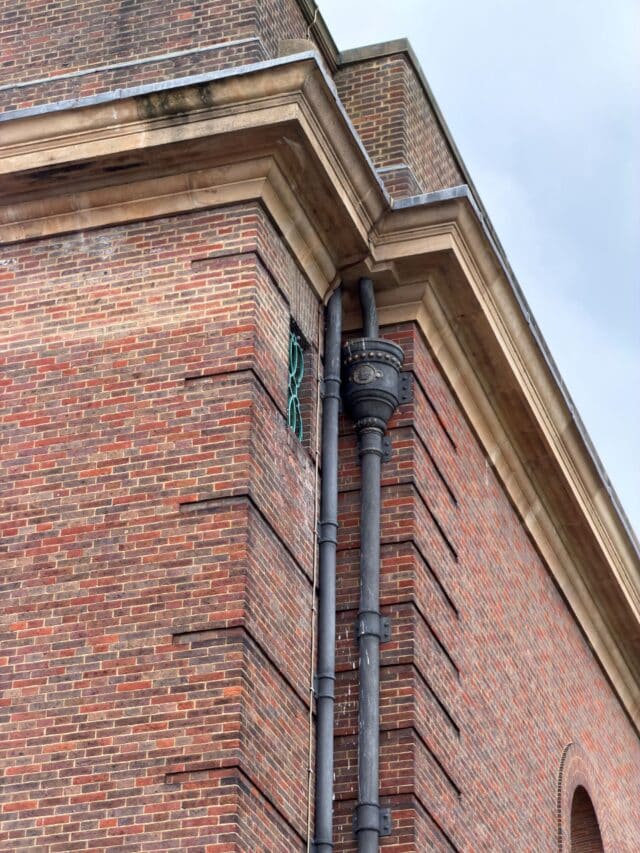
Drainpipe where our resident Kestrel roosts
Leaving the Great Hall, think about the loft spaces above the two long corridors. Those gable lofts extend the full length of the corridor and can be accessed through a secret hatch. Over the years people have used them to store things away. No-one knows everything they hold; but we have had explorations and have discovered what could be called hidden treasure. There is a brass telescope that was once used by the Astronomy Society to watch the night skies from the top of the clock tower. We recently discovered a portrait we did not know about. It is of Edmund Spenser. He was a Merchant Taylors’ pupil and is the most important English poet between Chaucer and Shakespeare.
There are only two other portraits of Spenser, and the newly discovered picture is of national importance. Talking of nationally important paintings, next time you are in the Dining Hall, look up. In the ceiling there are three oil paintings by Eric Ravilious. He is one of the most important painters of the first half of the 20th Century. We found them when we removed a false ceiling in the Dining Hall about 8 years ago. They had been hidden for over 30 years. It was pure chance that led me to go into the Dining Room in the summer holidays and prevent workmen from painting over them, as they painted the walls of the room.
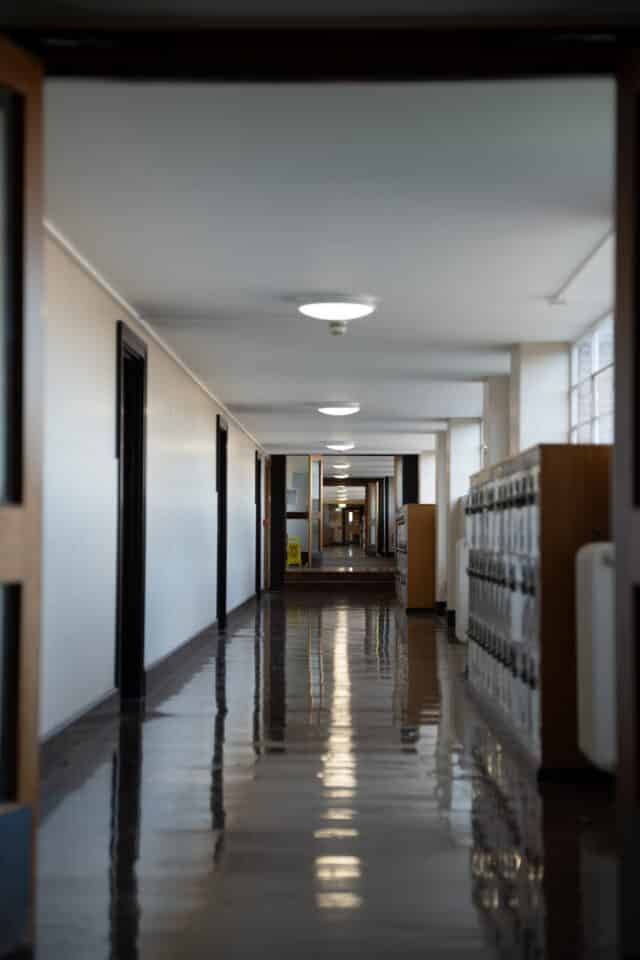
One of our long corridors next to the Great Hall
Staying with things on the walls of our school, there are plenty of things you might have missed, despite walking past them every day. Don’t miss the carved names of the Monitors, chiselled into the wood of the tables they sat at. Monitors still carve their names today. There is a wonderful quotation from the Apocrypha – the unauthorized parts of the Bible – in the corridor near the Physics Department. It asks questions about humans and their relationship with God and the universe, ‘Who hath seen him that he might tell us? And who can magnify him as he is? There are yet hid greater things than these be. For we have seen but a few of his works.’ These great lines are very suitable for Physics, and were chosen by Spencer Leeson, a Head Master who later went on to become Bishop of Peterborough. Finally, with regard to things hanging on walls, see if you can find the bronze plaque, put on our walls in tribute to Robert Clive, the OMT who established British rule in India. It paints a very positive picture of the man and his works. Then read the newer plaque beneath it, written by some Sixth Form pupils just a few years ago. I think that second plaque is a more honest assessment of Clive, and it is beautifully written.
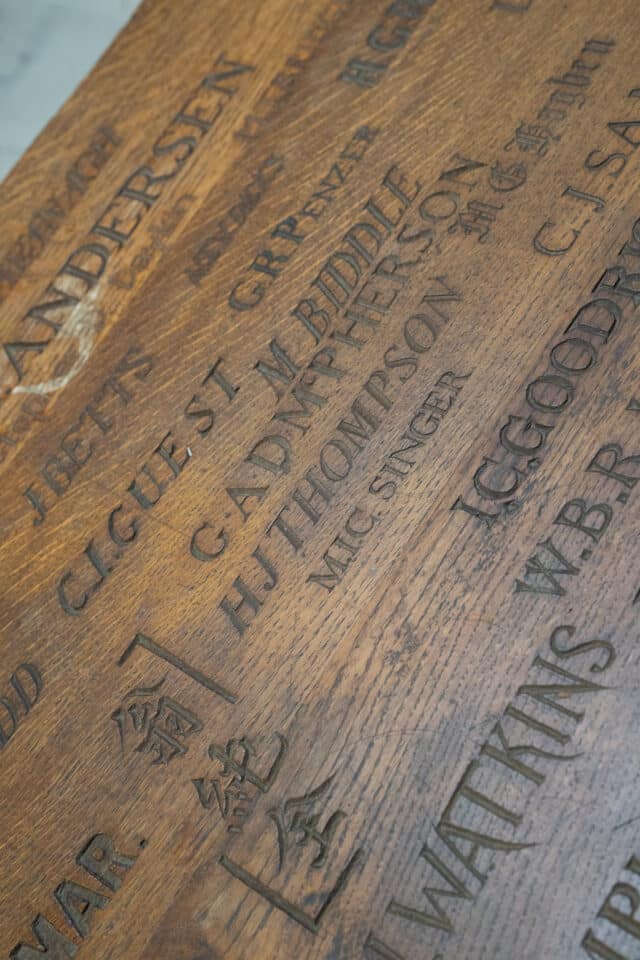
Carvings of names in to the Monitor tables
I wonder if you know about the hidden Head Monitor office? I found this space for the Head Monitor and those in his Monitor team to use. The office is in the clocktower at the end of the Inner Quad. It is accessible through a doorway blocked with a grille and a padlock, in the most northerly of the three arches under the clocktower. Unless you are looking for it, you would never see it. To get to the hidden office, you have to know the code for the padlock and then climb the spiral staircase up into the Tower. One person in every year group listening to me will one day be made Head Monitor, and he will then be told the padlock combination to use to get in.
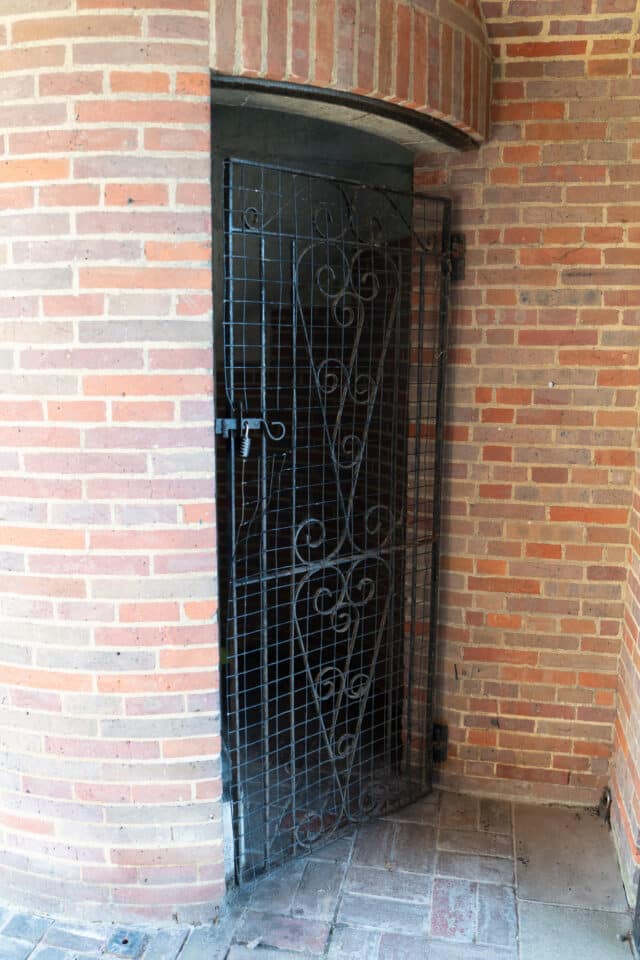
Head Monitor office entrance gate, leading up to a spiral staircase
I don’t think any Head Monitor will be allowed to go to the next place I am going to describe to you. We don’t allow pupils to go into the many tunnels that are under the buildings we use. Here are some pictures of them. They allow heat pipes to carry warmth around the site and also take power cables and fibreoptics. There are scores of them, and they run under every building and every green space. Some are quite wide; others are terribly tight and low. If you were claustrophobic, there is no way you could get through the one that runs under the main quad. Years ago, my wife and I had a kitten that escaped into the tunnels and (being quite shy) decided to stay there. Goodness knows what he was eating; he escaped all my attempts to explore the tunnels to find him again. The kitten was down there for almost two weeks, before we managed to recapture him with a humane fox trap and an open tin of tuna.
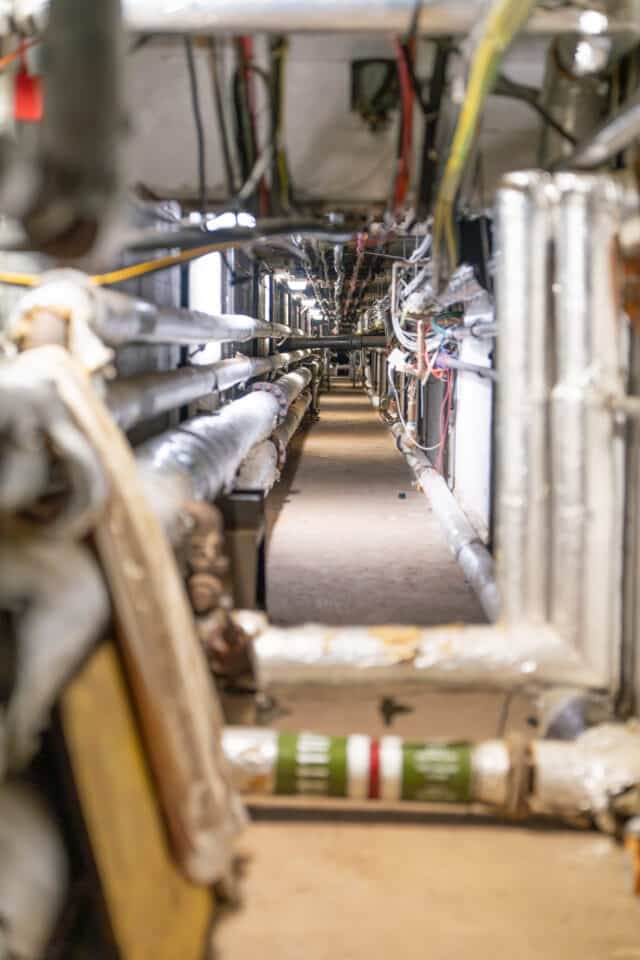
Tunnel underneath the School, this particular one goes underneath the Head Master’s corridor and reception
Now let’s consider our beautiful grounds. The lovely plants you see decorating the inner quad have a dark secret. If you know the technique, you can use them to make ricin. Ricin is a toxic protein and can cause severe poisoning if you breathe it or eat it. It is one of the most poisonous substances known. It is of special concern because of its potential use as a biological weapon. I’m not sure that whoever planted the Inner Quad with these plants was fully aware of their actions. In the meantime, please do not use any plants you find around the school to make biological weapons. In truth, I would not have told you if there were any chance you could – there are probably only a handful of Biology or Chemistry teachers who could do it.
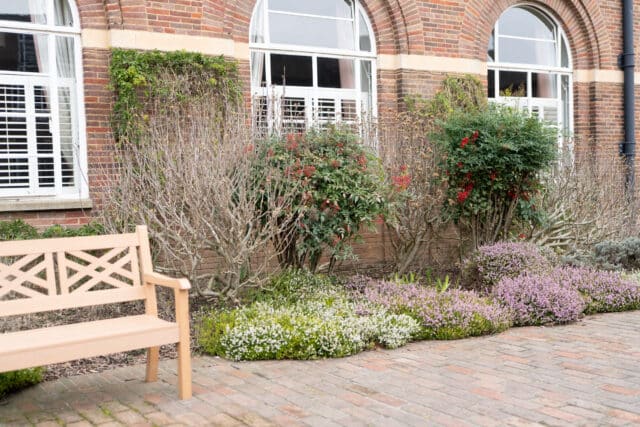
Plants around inner quad
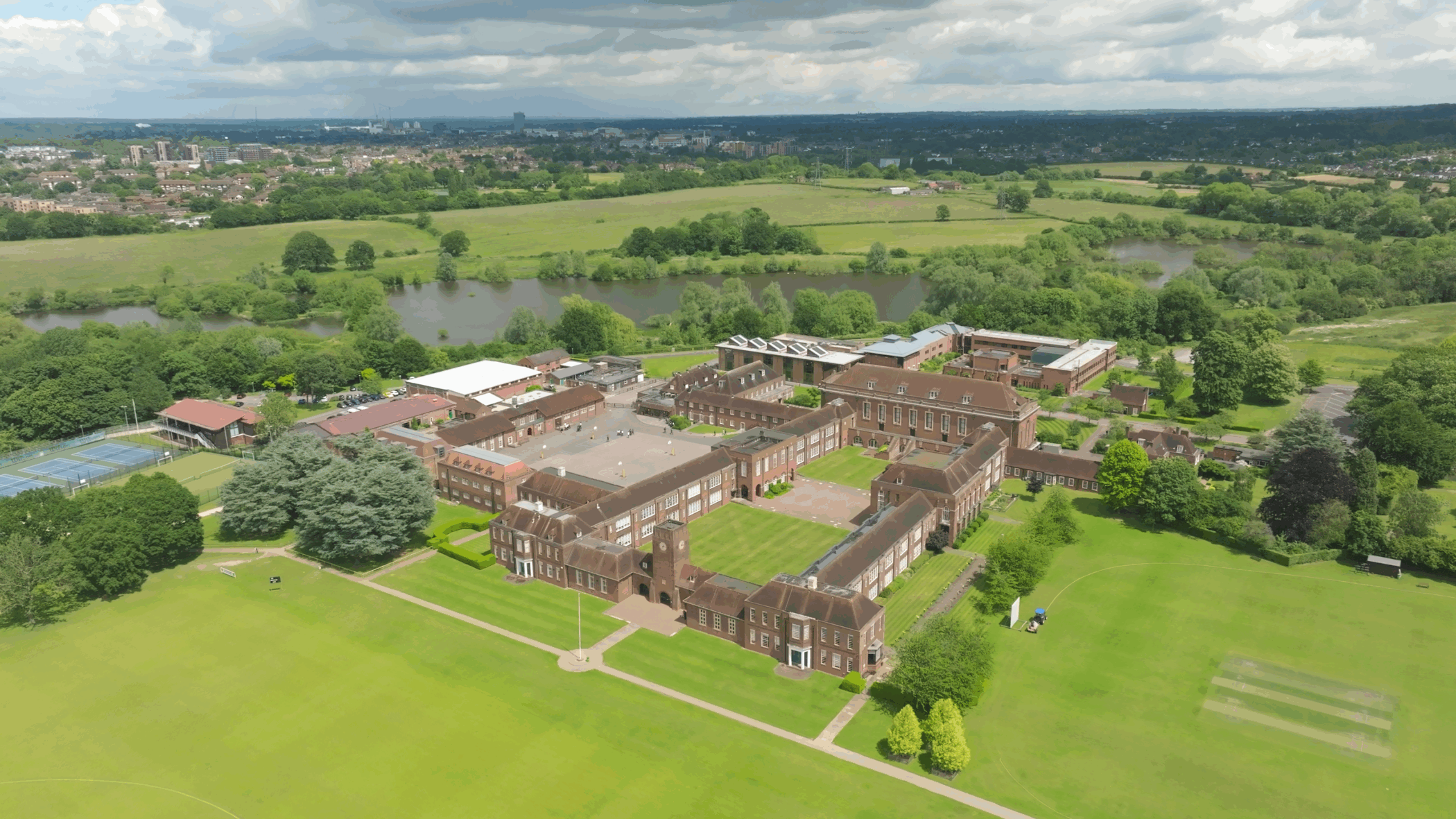
We have five lakes and a river on our grounds. The river is one of the very few chalk streams in the world and is a protected environment. The lakes are not natural – they were dug to collect gravel for construction. The gravel was left over from one of the various Ice Ages that have taken place over the last few million years. You may be aware that the Ice Ages are not over – we are just living in a warm interglacial period before the ice returns and makes the UK uninhabitable again. On one of those glacial maximums, the ice reached as far south as our playing fields. When it melted, it dumped all the broken rock, sand and gravel it was carrying. That was later dug up to make our lakes. I have variously heard that the gravel went to build either the old Wembley Stadium or the M25 – I don’t believe either. Wembley Stadium was built in 1923, which is too early and the M25 was completed in 1986, which is too late.
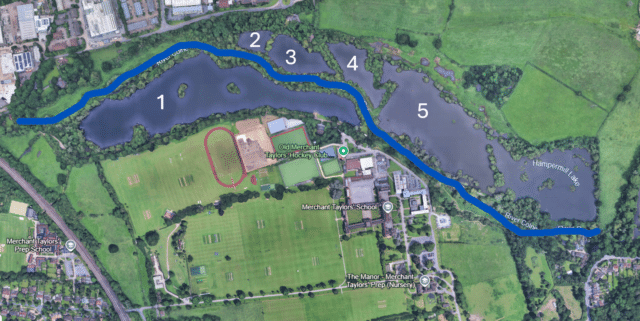
Aerial shot of our five lakes
The last piece of information I have for you today is about the Long Drive. Many of you will walk down it today. There is good reason to believe that the Long Drive is an ancient track way dating back to the Iron Age or even earlier. A member of staff has used his metal detector to find many Roman coins alongside it, so it was definitely in use in Roman times.
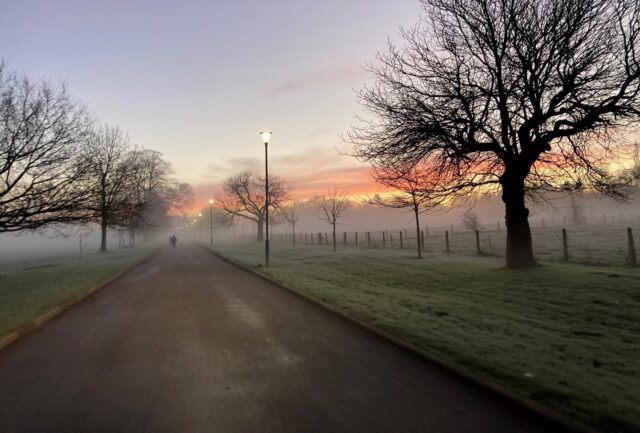
All this history and wonder, all around us: the extraordinary everyday. Do keep your eyes open as you go around the school today.