
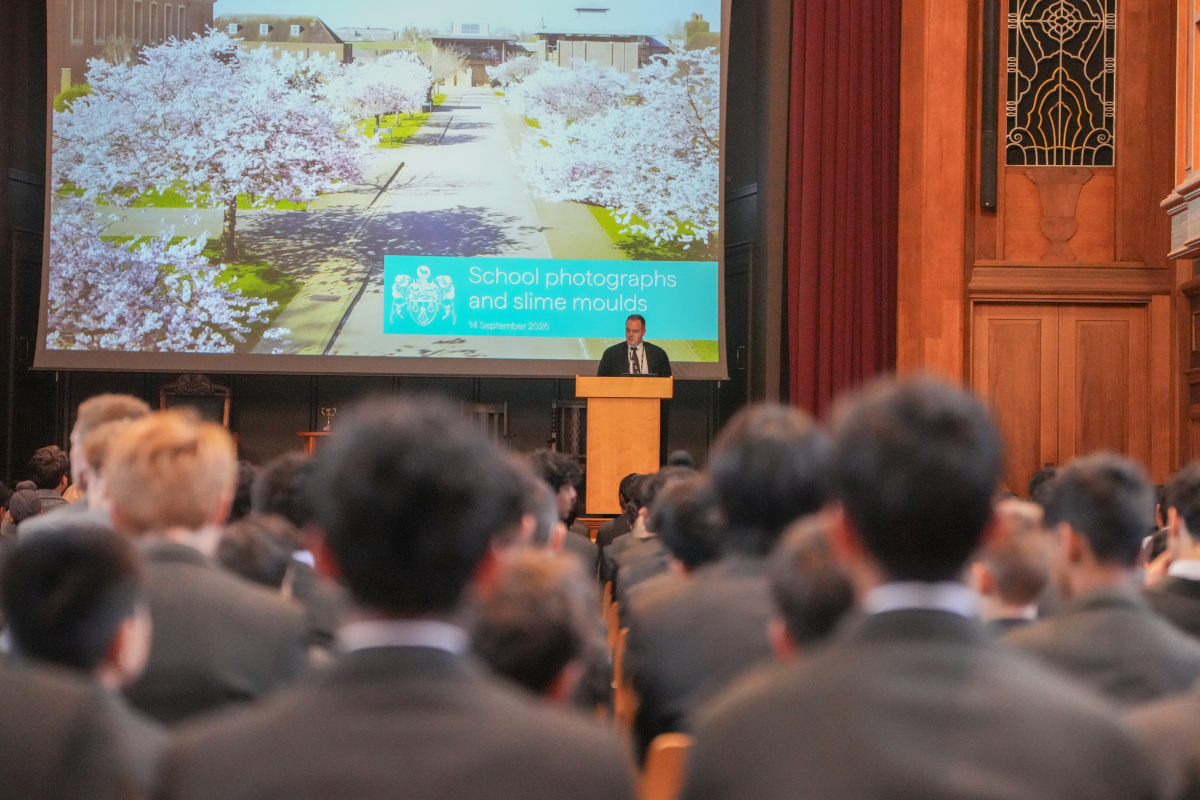
Today we have a Whole School Photograph, and on a scale that very few in this room will have experienced before. They are rather special occasions. They capture a particular pinpoint in time – in years to come many will look back at the photograph, perhaps to reminisce about friends, perhaps to spot a then schoolboy who will become a Prime Minister, Olympian or Nobel prize winner; or perhaps simply to marvel at the popularity of the textured crop hairstyle in 2026.
They are also special occasions in the immediate: for a few minutes, every pupil from each year and many members of staff will come together in the same place at the same time, and this reminds us that we are part of something very much bigger than a collection of individuals, but as a community. When we come together, which can do incredible things.
In this way, we are a bit like slime moulds.
Slime moulds are single celled amoeba-like organisms that we find on rotting plants. We find them everywhere: in soil, lawns, woodland floor, commonly on deciduous logs. In urban areas, they are found on mulch or even in the leaf mould in rain gutters. There are about 9000 different species, and they are quite a diverse group. We used to classify them as fungi, although we now suspect they evolved along different lines.
I find them interesting because for most of the time they exist as single cells. And they exist as single cells because times are good. Abundant food, space, water, the right temperature, the right pH. When things are going well, they are fine. If they find the right mate (and there are mating types) then they form a new cell, which goes off on its merry way as a new individual cell. But when times are harder, they come together.
When food is in short supply, many of these single-celled organisms will congregate and start moving as a single body. The cells remain as individuals but secrete a slime that starts to bind them together. They go looking for better conditions. And scientists have been astonished by what these slime moulds can do. They are no more than a bag of individual Amoeboid organisms surrounded in a thin slime sheath, yet they manage to have various problem-solving behaviours that are equal to those of animals who possess muscles and nerves with ganglia (ganglia are collections of nerve cells) – that is, animals with simple brains. These slime moulds are single cells, but they work as a superorganism.
Research on these slime moulds was started by Toshiyuki Nakagaki, a professor at Future University Hakodate in northern Japan, who cultivates the slime in petri dishes. And as you can see here, he started investigating their behaviour in mazes.
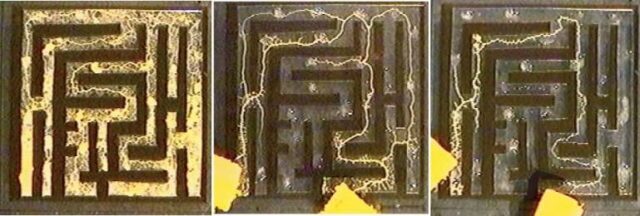
The maze was created by laying a maze template down onto a small plate of agar. In the first part of the experiment, pieces of slime mould were placed throughout the maze. The slime mould then grows out tube-like structures called pseudopodia, and it soon fills the entire maze. The maze had four routes through, to get from one exit to the other. Food was placed at both exits, and after eight hours, the slime mould had shrunk back so that its ‘body’ filled only the parts of the maze that were the shortest route from one piece of food to the other.
The researchers suggest that as the parts of the slime encounter food, the individual cells start to move more frequently and create a coded rhythm which sends out waves to other parts of its body signalling whether to grow further or contract. Ultimately, to maximise foraging efficiency, the superorganism contracts into one thick tube, running through the maze.
Mathematicians in the room will be familiar with these kinds of shortest route puzzles, where the most efficient route between different points is determined.
Nakagaki and his team tried these kinds of problems with the slime – here you can see the slime growing between oat flakes placed in a pattern representing major districts around Tokyo. The structure of slime that emerged looked almost identical to that of the rail system surrounding Tokyo, with a larger number of strong tunnels connecting centrally located oats and creating the most efficient networks available (and indeed better than the original engineers of the Tokyo subway conceived).
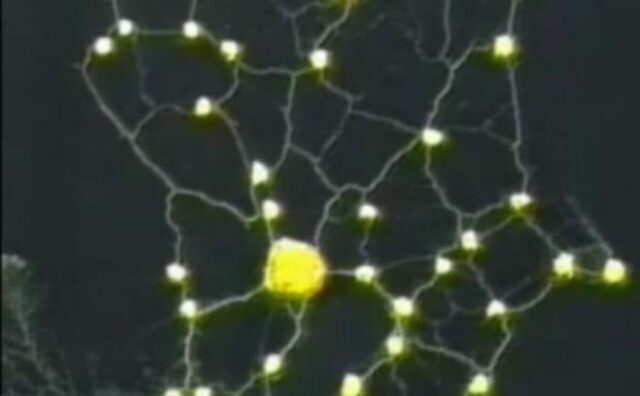
Researchers now use these slime mould in infrastructure planning – here you can see some experimenters giving the slime some 3D problems to plan the best route for roads or railways through an undulating landscape. And now computer scientists have turned this behaviour into a search algorithm. Instead of searching for food, the algorithm searches for the best solution to a mathematical problem and is being used in all manner of technologies.
I am telling you this because slime moulds, like coming together for a school photo, give us cause to reflect on what we can achieve as a community of individuals. When times are good, we can be fine as individuals; but when times are harder – and they will, for all of us, at times be hard, it is important we work together, communicate together, solve problems together, learn together, and pull each other along. This is true whether we come together as a tutor group, a class, a team, an ensemble, a House, and today as a whole pupil body.
The Merchant Taylors’ Company expressed a not dissimilar idea in its motto, which is also our school motto: Concordia res parvae crescent; “In harmony small things grow”. Our whole-school photograph, and even the strange behaviour of slime moulds, remind us that our school motto points us towards the same idea: we achieve much more together than we ever can alone.