


Welcome back! I hope you had a wonderful break and are refreshed and excited about the year ahead.
It is a new start for everyone, but I especially welcome those who join us for the first time in the Thirds and the Fourths and new entrants to the 6th Form. We can all look forward to a year of challenge, excitement, inspiration and discovery. I would like to celebrate the achievement of the new Lower Sixth, who posted the school’s best ever set of grade 9s in their GCSEs. Getting on for 40% of all GCSEs were awarded a grade 9; it was the most commonly awarded grade. 20% of students achieved only 9 and 8s (A*) in all their subjects; nearly half of students achieved only 9-7s (A*-A) in all their subjects.
They are not here, but we should also celebrate our Upper Sixth leavers. They are about to go on to university, with the highest set of A Levels the school has seen. 36% of all entries were awarded A* grades. 27 pupils achieved three or four A*s. More than half received only A* or A grades.
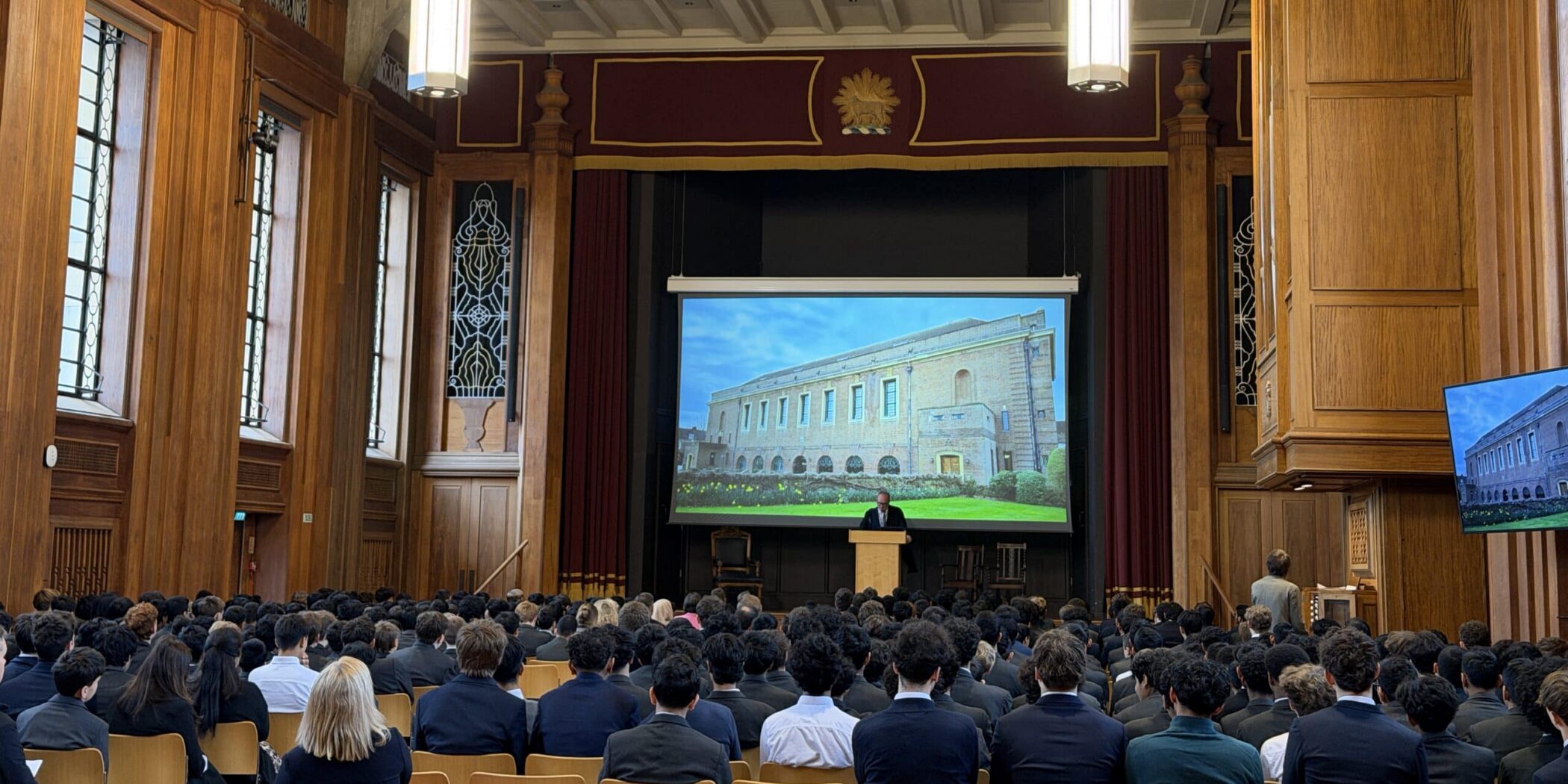
You come back to a school that has improved its facilities over the summer. There is a new Astro by the new Cricket Centre, the lecture theatre has been upgraded, and we are about to start work on refurbishing the changing rooms and indoor sports areas. That cheers me up immensely, but I am aware that my sunny disposition is at odds with the way we are encouraged to view the world at the moment. On pretty much every key topic, we are presented with relentless bad news. Climate change, wars in Europe and the Middle East, public services in Britain, governance, Brexit, riots, new taxes. All give real concern. I do not want to downplay their seriousness, but in addition to facing up to the challenges in the world, let’s not lose sight of the progress that is also being made.
So, here are some examples of under-reported good news.
Britain recently become the first G20 country to have halved its carbon emissions. We extract more power from less fuel in a cleaner way. The average household uses 40 per cent less energy than in the mid-1990s.
This has many benefits: the air in our cities, for example, is the cleanest since records began. We are rewilding – introducing animals that were once lost. Once again red kites fly overheard and beavers are working our rivers.

The world’s economic output this year hit an all-time high, finally recovering from the pandemic. Wealth is also shared more widely than at any time in living memory, with global inequality at a 150-year low. Just a decade ago, almost 850 million people in the world lived below the extreme poverty line; now the figure is 610 million. That is still a lot of people, but we can celebrate the equivalent to 65,000 people being lifted out of poverty every day. More of the world can now afford a better diet and the basic facilities that so many of us in the West take for granted.
Whilst the headlines focus upon earthquakes, fires and natural disasters, deaths from natural disasters are a fraction of what they were a century ago.
For all the doom-mongering, in most places in the world this is the best time to have ever been alive.
Let’s consider some other, under-reported things that bring hope – and which we can expect to see improving our lives in the year ahead.
Genetic engineering is one. It is hard to believe it has been only a decade since the development of Crispr — molecular scissors that enable the editing of the genome. The tool has since become integral to plant science, animal science and bacteriology. Its creators have won the Nobel Prize.

Image credit: Guido4, Wikipedia
But its great promise was always medicine: that it offered a way to hack the human body itself to cure disease. Sickle cell anaemia has just become the first condition to be treated with Crispr. But this will not be the first Crispr treatment. This is the year the world gained a new branch of medicine.
There is more good news in medicine. Well over 600,000 people die of malaria each year. Most of the deaths are in children; nearly half a million African children die from malaria annually. All that is about to change, thanks to a cheap malaria vaccine developed by Oxford University, after 30 years of research. British scientists have ensured that more children are going to be saved from death in Africa.
This year will see a new era of space exploration; we are going to the moon, Mars and other distant worlds. In 2025, the Artemis programme plans to put people on the lunar surface for the first time since Apollo 17 in 1972. In previous assemblies, I have already mentioned trips to Jupiter to assess the habitability of Europa. Mars is also on the agenda, with a robotic mission launching this month. India is due to send an unmanned spacecraft to Venus. It will look at the chemistry of the atmosphere. That will include looking for signs of phosphine, a substance associated with life that previous studies have hinted may possibly be present. There is plenty to look forward to there.

Image credit: Andrea Luck, Wikipedia
The last year is probably the one that historians will identify as the moment that AI really started to break out. Some, see that as a threat. Others think that those who see a danger to humanity have been reading or watching too much science-fiction. As the worst-case scenarios tend to grab the media limelight, we will put on our rose-tinted glasses to look at the year ahead. First, “generative” AI probably won’t come to take too many jobs, just yet. It’s just not accurate enough. However, it will start to take the boring bits out of many white-collar jobs, especially if you have to summarise documents, or write and read reports.
These are just a few examples of many pieces of good news that I could have shared. All are cause for hope and joy.
If we are to face the real challenges that exist, we will be more likely to overcome them from a position of optimism and gratitude, than despair. We should look for opportunities to feel grateful and delighted – the simpler and quirkier the better. It doesn’t have to be a new breakthrough medicine or brilliant achievement. Delight is all about revelling in tiny novelties – nothing is too transient or silly for inclusion.
May I suggest that you practice the art of optimism this year. Try thinking about the past few days and jotting down a list of simple things that have already made you smile. Top of my list were: The Times crossword on Saturday morning, feeding apples to two happy pigs, unexpected good news on a needed car repair, the growing flock of Egyptian geese on our grounds, seeing a kestrel roost on the side of the Great Hall this morning, listening to Test Match Special and eating oysters at Whitstable. And I haven’t got anywhere near to the bottom of my list yet. If you do the same, if you find reasons for gratitude and delight, you will boost your levels of happiness.
And as we are continually fed the bad news stories that grab the attention and raise our levels of anxiety, try also to look for the good news and savour it. It is in our nature to be fixated by the bad. I guarantee that if ten people say nice things to you over the course of the day, and one person criticises you, you will end the day thinking about that single bad comment. Let’s recognise that trait, but not give in to it. If you take positive steps to feel grateful and delighted, the year ahead will be even more successful, and it will be full of joy.
Give it a go



.png)