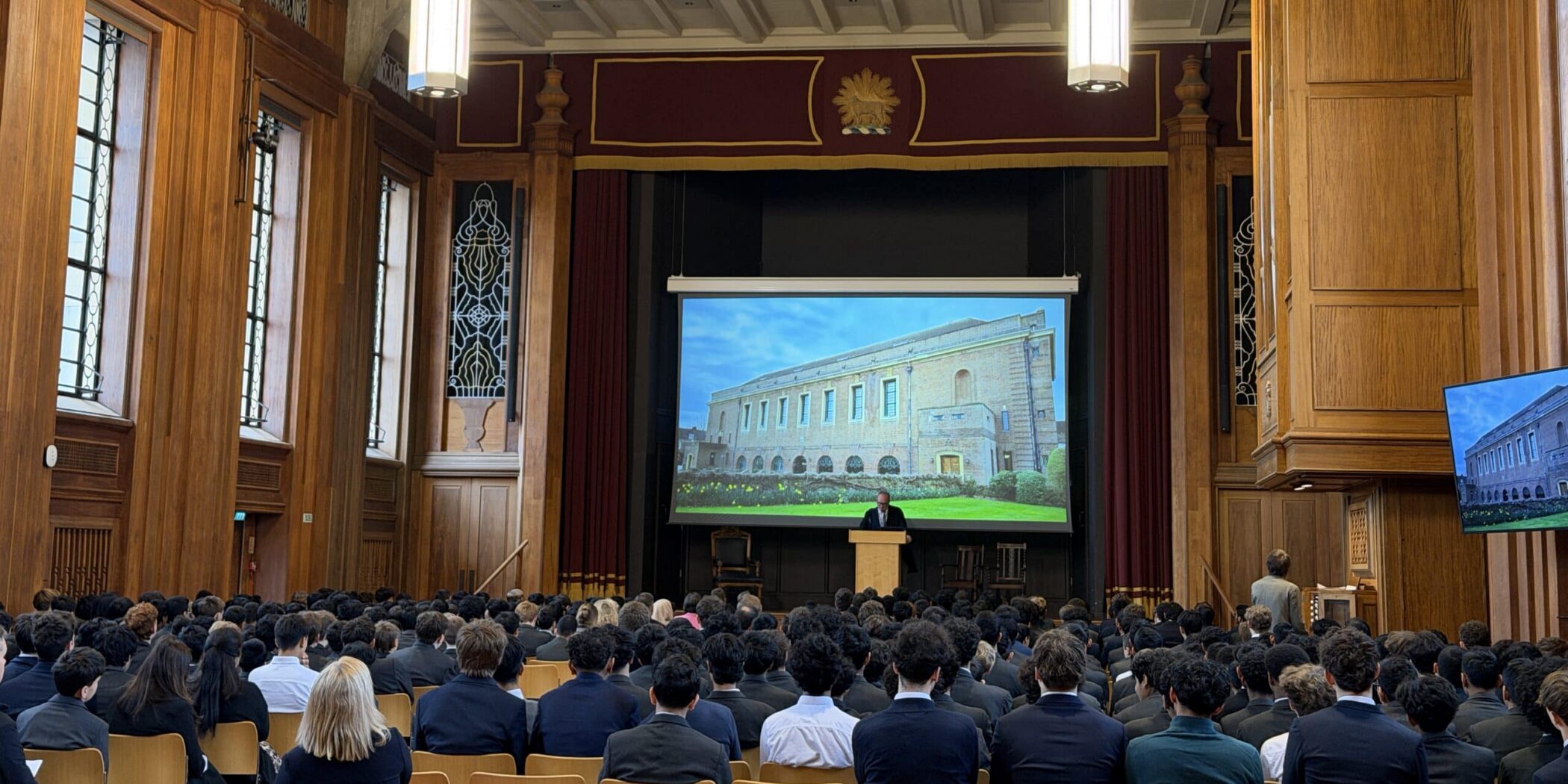


Our sense of ourselves is fundamental to our being. Who we are defines our relationship with everyone and everything else. I am talking about that unique consciousness that you discover when you look into yourself in introspection. So, I would like to think about consciousness this morning. Let’s begin with a question, ‘Who are you?’ You will be asked this many times in your life. Mostly, you will attempt to answer it by giving your name. Today I want to go a little deeper. Your name is a shorthand for your personality, your identity, your unique consciousness.
It can feel as though it is quite easy to define that essence at your core, which animates your life. After all, you probably think you have direct, unmediated access to it, and indeed I bet you are aware of yourself as a person right now as my words focus your attention on it. I’m not sure it’s as easy as that. I think your consciousness is more complicated and uncertain than many might think. Let’s first explore that and then ask what the implications might be.
We start by asking an apparently simple question: What is ‘me’ and what is mine?
‘Me’ is my identity, my core, my consciousness. That is a distinct and separate thing from the things that are mine. They are owned by me and are separate from me.
But are ‘me’ and mine so different?
Possessions are definitely mine. They are objects that exist in the world independently of me. But wait a moment. I am also, to an extent, defined by what I have. I chose these things. Say I bought a picture to put on the wall of my house. That picture on the wall is an expression of my taste. It offers an insight into me and what makes me, me. That picture was bought by me and is owned by me, but it is very much a part of me. Can we be untangled from what we possess? If someone were to take everything away from you, leaving you on a desert island with nothing, would you be changed by that experience, or would you continue as you are, unaffected in any way? I think the honest answer is that we would all be affected, but that we would not feel that the core of our personality had been compromised. Your likes, dislikes, hopes and fears would probably be amplified, but not profoundly altered.
Where else might we ask the question, what is me and what is mine? There are deeper and closer areas to look. What about your emotions? Take an example – what if you felt angry in a particular moment. Is that anger you or is it owned by you? This feels like a harder question than the one about possessions. The anger is an emotion that was not there earlier and will (hopefully) soon pass. That suggests that it is not essential to the inner sense of ‘me’. It is currently owned by me but will soon not be owned. It is disposable, not essential. That would make my emotions something that are mine, but not ‘me’. However, emotions must be closer to the essence of you than an object that you own. When you feel anger, you are altered by it. Your decision-making will change. The anger is a true expression of your being and if it is real, it may consume you and fill you up. Nevertheless, one would probably want to say, ‘I am angry’, rather than ‘I am anger’. The first sentence makes a separation between you, and the anger you are feeling. The second doesn’t and feels more clunky and odd.
The matter is complicated by the apparent fact that some emotions are not so quick to pass through us. Some emotions can seem rooted in our nature. My tendency to look on the bright side of things is definitely an emotional attitude, but it feels a lot more like ‘me’ than something that is mine.
Then we come to emotions such as love. Love is a profoundly life-altering emotion. It is a sense of devotion and attachment to another, whether a life-partner or a child, or a parent, or God or whatever you have connected with. Few would want to separate their sense of ‘me’ from their love. Indeed, love is very much a merging of two selves. So when it comes to emotions, it seems that the question what is me and what is mine is complicated. Emotions are owned by us and they also seem to own us. Our identity and consciousness is entangled with feelings, some of which will pass through us quickly, others of which will linger and could well come to help define us.
What about your body? Is your body owned by you, or is it part of you? Your sense of yourself as a physical object in space is a defining characteristic of your identity. Your appearance, the skills and capacities associated with your sporting ability, your height, whether you are male or female, whether you are sick or well: all of these will impact deeply on who you are. They are surely too close to the central ‘you’ to be considered mere possessions of yourself, which can be discarded without altering the essence. Most modern psychologists and philosophers would propose that there is a deep and important connection between your physical presence in the world and your mental one. Even so, whilst the two are closely linked, I am not sure how many in the room would be willing to claim that they are the same. Who I am is not the same as what my physical body is. I would be happy to say that I have a body, but less comfortable to say that I am a body.
But what about the mind itself? Would you prefer to say, ‘I have a brain’, or would you prefer to say, ‘I am a brain’? If you say the first, you are separating your consciousness from the object that creates it; there is a thing which is you, which is separate from and which owns the brain in which your consciousness exists. If you prefer the second, you are describing yourself as a physical object and do not distinguish between the mind and the organ that does the thinking.
If you want to be a body, not have a body, then your consciousness is tangled up with all the messy physicality of the chemical and neural machinery of the brain. You are very much a product of forces outside your control. If you want to have a body, independent of the brain, then just what on earth are you, and how do you connect to the body that hosts you? Your essence is far from clearly understood – no wonder the problem of consciousness is called ‘The Hard Problem.’ The question of who you are, what is me and what is mine and the nature of consciousness is at the heart of every Humanities subject you study. I bet you find it resonating through your lessons today.
At every level, from the ownership of emotions to the ownership of the body, to the relationship between mind and brain, the you that is you is elusive and entangled. ‘It’s complicated’ seems to be the message. And yet the one thing we seem to be sure of is that you experience your own consciousness – that you exist. So much so that Descartes based knowledge of everything else in the world upon it. You know his phrase – ‘I think therefore I am.’ The ‘I’ bit is not in doubt.
Having discovered that the apparently direct access we have to our own sense of self is a little more complicated and confused than we might have thought, we should end by asking what the implications of that are.
One question is whether, given identity is uncertain, we should be held accountable for our actions. Our society is built around the idea that we are responsible for our own actions and we must bear the consequences for them. The system of justice is obviously founded upon that thought, but so is just about every other social interaction. However, if we allow ourselves to question the nature of the central consciousness that is making the decisions, if the consciousness which is supposed to be making the decisions is fuzzy and if it is affected by other factors outside our control, there is a risk that ideas that are fundamentally important to the good working of society are eroded. There are two such threats – the first is that our choices are all or largely predetermined by external factors such as our genetic inheritance. That removes the ideas of human agency and responsibility. The other is the idea I have been discussing this morning – that the nature of the consciousness making the decisions is too indeterminate for it to be a responsible actor.
Where does all this leave us? I think that we have found some deep problems in asking what is me and what is mine. Nevertheless, I am not yet ready to abandon the idea that we all really do possess identity and consciousness and can make free decisions on how to act in the world. My advice to you, if you are sent to me to account for a misdemeanour, is not to argue that you should not have a detention because you were the victim of outside forces beyond your control. I will persist in arguing and believing that your actions are the product of choice, of free will. That belief looks increasingly like an act of faith, rather than a rational and supported conclusion. However, it is too important to set aside. To pick up a question recently posed in the philosophy debating group, perhaps there are some truths we should not know.